
Electric Patio Heater Cost To Run: Hourly, Monthly Costs
Before you plug in that patio heater this season, it's worth knowing exactly what it'll cost you. The electric patio heater cost to run depends on a few key factors, wattage, local electricity rates, and how many hours you actually keep it on, but the numbers can add up faster than most people expect. A single 1,500-watt heater running a few hours each evening can quietly push your electricity bill up by $20 to $40 or more per month, depending on where you live.
That ongoing expense is one of the reasons we built wrmth furniture. Our heated Muskoka chairs deliver warmth directly to your body instead of blasting hot air into open space, which makes them far more efficient than traditional patio heaters. But whether you're weighing a standard electric heater, a propane unit, or something different altogether, understanding the real operating costs is the first step toward a smarter decision.
This article breaks down exactly what you'll spend to run an electric patio heater, by the hour, by the month, and by the season. We'll cover how wattage and electricity rates affect your bill, compare electric heaters against propane and natural gas alternatives, and help you figure out whether the running costs make sense for how you actually use your outdoor space. No vague estimates, just real numbers you can work with.
Why electric patio heater running costs vary
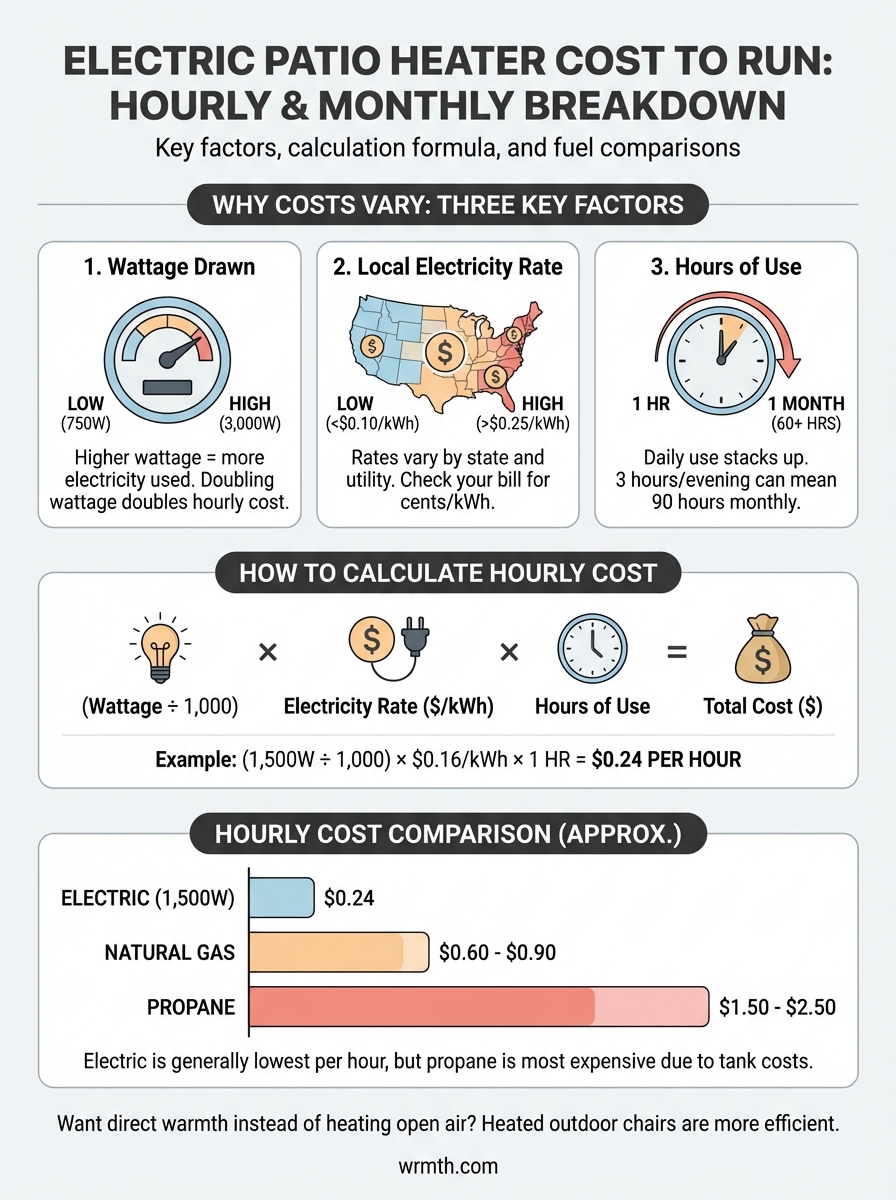
Not every electric patio heater costs the same amount to run, even if two units look nearly identical on the shelf. The electric patio heater cost to run depends on a combination of variables that interact with each other, so a rough estimate from a friend or a product listing rarely tells the full story. Three factors drive the bulk of your actual expenses: wattage, your local electricity rate, and how you actually use the heater.
Wattage determines how much power the heater draws
Most residential electric patio heaters fall somewhere between 750 watts and 3,000 watts. A smaller tabletop unit at the low end draws far less power than a ceiling-mounted infrared heater at the high end. The higher the wattage, the more electricity the unit pulls from the grid every hour it runs, which directly inflates your bill.
A 3,000-watt heater uses exactly twice the electricity of a 1,500-watt heater for every hour you run it, which means the wattage you choose can literally double your operating costs.
Many heaters include multiple heat settings, which lets you run at lower wattage when conditions are milder. If you rarely use the highest setting, your real-world costs will be lower than the maximum rated wattage suggests.
Your electricity rate changes everything
Where you live has a significant impact on what you pay. Electricity rates in the U.S. vary widely by state, ranging from under $0.10 per kWh in states like Louisiana to over $0.25 per kWh in Hawaii and parts of New England. Running the same 1,500-watt heater for one hour costs about $0.10 in a low-rate state and $0.37 in a high-rate state.
Your utility company may also charge different rates depending on time of day or season, which means evening patio use could cost more than daytime use if you're on a time-of-use pricing plan.
Hours of use stack up quickly
Even an energy-efficient heater becomes expensive when you run it daily. Three hours per evening over 30 days adds up to 90 hours of runtime, and that volume of use is where monthly costs really climb. Your actual habits, not just the heater's specs, are what determine your real bill.
How to calculate your electric patio heater cost to run
The math behind the electric patio heater cost to run is straightforward once you know three inputs: wattage, your electricity rate, and total hours of use. You don't need any special tools, just your heater's wattage (usually printed on the label or in the manual) and your electricity rate from your monthly utility bill.
The basic formula
Your utility company bills you in kilowatt-hours (kWh), not watts, so the first step is to convert. One kWh equals 1,000 watts drawing power for one full hour. Use this formula to calculate your cost:
(Wattage ÷ 1,000) × Hours of Use × Electricity Rate ($/kWh) = Total Cost ($)
Once you run this formula across a few scenarios, you'll see exactly how quickly daily patio heater use adds up over a month.
A real-world example
Say you own a 1,500-watt heater and your utility charges $0.16 per kWh, which is close to the current U.S. national average. Running it for three hours costs: (1,500 ÷ 1,000) × 3 × $0.16 = $0.72 per session. Run it five evenings a week for a month and you're looking at roughly $14.40 from that single heater alone.
Now factor in two heaters running at the same time, and that monthly cost doubles. Scale your estimate up or down based on how many units you plan to use and how many evenings you realistically spend outdoors.
Typical hourly and monthly costs by wattage
The simplest way to understand the electric patio heater cost to run is to look at hard numbers across common wattage levels. Using the current national average electricity rate of $0.16 per kWh, the table below shows what you can expect to pay per hour and per month, assuming three hours of use per evening and 20 evenings per month (60 hours total).
What the numbers look like across wattage levels
The table below maps hourly and monthly costs across the most common residential heater sizes. These figures use $0.16/kWh and 60 hours of monthly runtime as a consistent baseline.
| Wattage | Cost per Hour | Monthly Cost (60 hrs) |
|---|---|---|
| 750W | $0.12 | $7.20 |
| 1,000W | $0.16 | $9.60 |
| 1,500W | $0.24 | $14.40 |
| 2,000W | $0.32 | $19.20 |
| 3,000W | $0.48 | $28.80 |
If you live in a state with rates above $0.25/kWh, multiply these monthly figures by roughly 1.5 to get a more accurate estimate for your actual bill.
Running multiple heaters at the same time changes this picture quickly. Two 1,500-watt units running together at $0.16/kWh will cost nearly $29 per month under that same usage scenario. Before you buy, count how many heaters your space actually requires, because that number has a bigger impact on your total bill than the per-unit wattage alone.
Electric vs propane vs natural gas cost comparison
When you compare the electric patio heater cost to run against propane and natural gas alternatives, the difference is sharper than most people expect. Each fuel type carries its own cost structure, and the cheapest option per hour isn't always the cheapest option overall once you account for setup costs, fuel availability, and actual heat output.
Electric heaters tend to win on operating cost per hour, but propane units offer portability that wired setups simply can't match.
Running costs side by side
The table below compares approximate hourly operating costs for a standard patio heater across all three fuel types, assuming similar heat output levels and average U.S. fuel prices.
| Fuel Type | Approx. Cost per Hour |
|---|---|
| Electric (1,500W) | $0.24 |
| Natural gas | $0.60 to $0.90 |
| Propane | $1.50 to $2.50 |
Propane heaters are by far the most expensive to run. A standard 20 lb propane tank costs around $20 to $25 and lasts roughly 8 to 10 hours on a typical patio heater, which pushes your per-hour fuel cost well above any electric option.
What the numbers leave out
Natural gas sits in the middle on running costs, but it requires a permanent gas line installation, which can run hundreds to thousands of dollars depending on your setup. Electric heaters skip that upfront cost entirely. Your main variable is simply the wattage you choose and the rate your utility charges, both of which you can control or at least predict before you commit.
How to cut your patio heating costs
Reducing the electric patio heater cost to run doesn't require buying new equipment or giving up outdoor time. A few straightforward changes to how you use your current setup can meaningfully lower your monthly bill without sacrificing comfort.
Use lower wattage settings first
Most electric patio heaters include two or three heat settings, and the highest setting is rarely necessary unless temperatures drop below freezing. Starting at 50% power on a mild evening and only stepping up when you actually need it can cut your hourly cost in half. Small adjustments in daily habits like this add up significantly over a full season.
Running your heater at 1,000W instead of 1,500W for a three-hour session saves roughly $0.24 per evening, which adds up to over $5 per month without any change to your routine.
Position your heater closer to where people sit
Patio heaters lose effectiveness quickly when they're placed too far from the people using them. Moving the unit closer to your seating area means you can run it at lower wattage and still feel warm. Open, windy spaces bleed heat fast, so positioning your heater in a sheltered corner or against a wall also reduces how hard it needs to work.
Add a simple outdoor rug or windbreak
Blocking wind and insulating the floor under your feet makes a real difference. An outdoor rug, a low fence, or a privacy screen all help retain heat in your immediate area, which means shorter runtime and a lower bill each month.
A simple way to plan your setup
Start by pulling your most recent utility bill and finding your rate in cents per kWh. Then count how many hours per week you realistically spend on your patio and how many heaters your space requires. With those three numbers, the formula from earlier in this article gives you a reliable monthly estimate before you spend anything. Doing this upfront takes about five minutes and saves you from a surprise on your bill.
The electric patio heater cost to run adds up faster than most people budget for, especially across a full season with multiple units running. If you want direct, personal warmth without heating open air, a heated outdoor chair delivers more usable heat per watt than any overhead heater ever will.
Before you commit to a setup that keeps running up your electricity bill every month, see how wrmth heated outdoor furniture works and whether it fits how you actually use your outdoor space.